
Barn-type house - a temporary fashion or the future of Polish construction?
.png)
Barn-style homes, also known as “modern barns,” are not just a new trend in architecture — they are becoming an increasingly popular choice among investors looking for a stylish, functional and energy-efficient place to live. They are characterized by a minimalist, compact form, large windows and natural materials, which makes the interiors full of light and harmoniously fit into the environment. In Poland, phrases such as “barn house design” are gaining popularity in Google Trends, which confirms the growing interest in this style.
According to industry data, the average cost of building a house-barn with an area of about 100 m² in the raw closed state is from PLN 150,000 to PLN 400,000, and in more detailed calculations it can reach up to PLN 500,000. Compared to traditional houses with a more complex form, the simplicity of modern barn construction translates into real savings both during construction and subsequent maintenance.
More and more investors, both private and developers, are opting for this style. What makes barn-type homes so attractive? In this article we will look at what exactly a barn house is, what advantages it offers, what challenges may arise and whether it is just a momentary trend or rather a solid foundation for the future of Polish construction.
The genesis of style - what is a “barn house”?
A few years ago, the “barn” was associated mainly with rural architecture. Today, barn-type houses, also known as modern barns, are one of the most popular projects in Poland — both by private individuals and developers. This trend, which has taken root especially strongly in the Scandinavian countries and Western Europe, is also gaining strength in Poland.
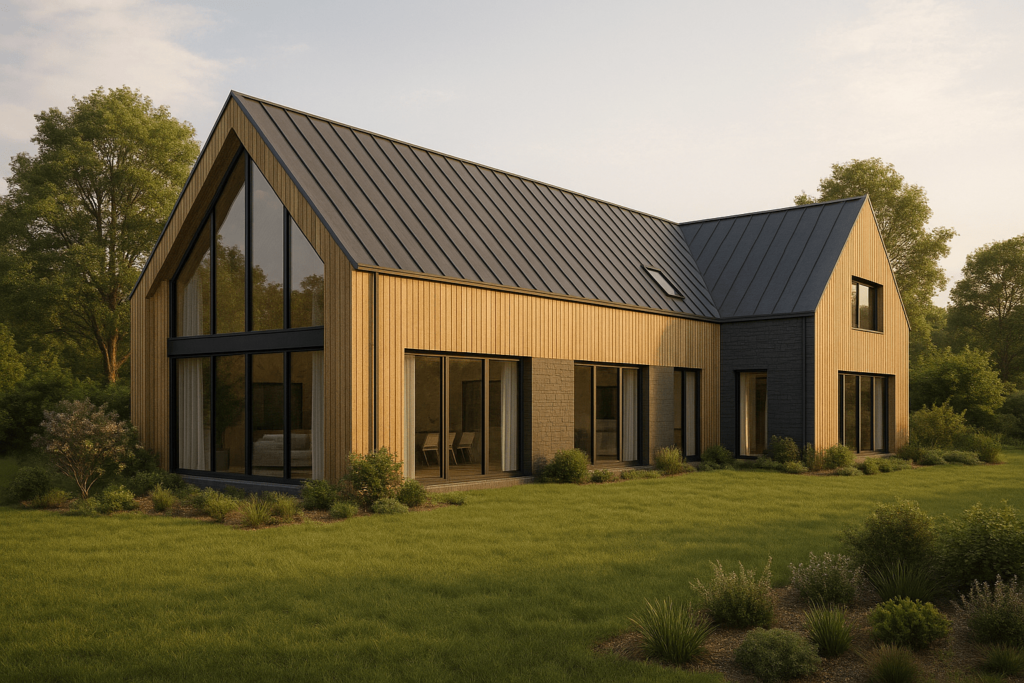
What makes a modern barn different? First of all, a compact geometric body, a gable roof without eaves, large glazing and natural materials such as wood, brick, concrete or sheet metal. But it's not just a matter of aesthetics — it's also an approach that emphasizes functionality, simplicity of construction and sustainability.
Where did the barn house come from?
The inspiration for this style was the traditional farm buildings that dominated Polish villages for years — they were simple, cheap to build and very practical. Contemporary realizations draw on this aesthetic, but give it a completely new quality. Architects and investors have recognized their potential to create modern homes:
- The shape of the barn fits perfectly into the trends of minimalism,
- The design allows fast execution, even to the raw state opened in a few months,
- In a nutshell — fewer details = lower construction costs.
This style has gained particular popularity in the Scandinavian countries and Western Europe, and for several years it has also won the market in Poland, both among private investors and developers.
What makes a barn style house stand out?
- Minimalist form — no dormer windows, balconies or bay windows,
- Interiors often with a mezzanine and an open ceiling above the living room,
- Panoramic glazing, extending from floor to ceiling, which create the effect of “interior-living room-gardens”,
- Facades made of wood, concrete or brick, which harmoniously fit the building into the natural landscape.
Individual project or from a catalog?
Most investors opt for ready-made barn projects, but individual projects are also becoming increasingly popular, the cost of which is about PLN 10,000 in Poland. Individual design allows you to fully fit the body to the plot, lifestyle and local zoning plan.
In the next part of this article, we'll take a closer look at the advantages and limitations of barn-style homes — from construction costs to comfort of use. This will help you assess whether this style is a temporary fad or maybe the future of Polish construction.
Advantages of “barns” in practice
Barn-style homes attract the eye with their minimalist form, but it is their practical advantages—from the construction itself to everyday use—that make them an economical and comfortable choice.
Simple solid = lower construction costs
Minimalist, geometric shape translates into lower investment costs. Here are some reasons why:
- The regular shape of the body and roof facilitates both the design and the construction itself.
- The absence of bay windows or balconies means less material consumption and lower labor costs.
- The simple design of the roof allows you to put the raw state faster and reduces the risk of execution errors.
In practice, the construction of a house in the style of a barn often costs from 10 to 20% less than the construction of a similar area in a more complicated form.
Energy efficiency incorporated into the project
A compact body means fewer thermal bridges and a smaller surface area of the external partitions, which translates into:
- Lower heating and cooling bills.
- Possibility to install modern solutions such as heat pump, recuperation or photovoltaic panels.
- Compliance with the rules of passive construction and high energy efficiency.
Research shows that modern barn-style homes can be more energy efficient than traditional frame buildings.
More light and space
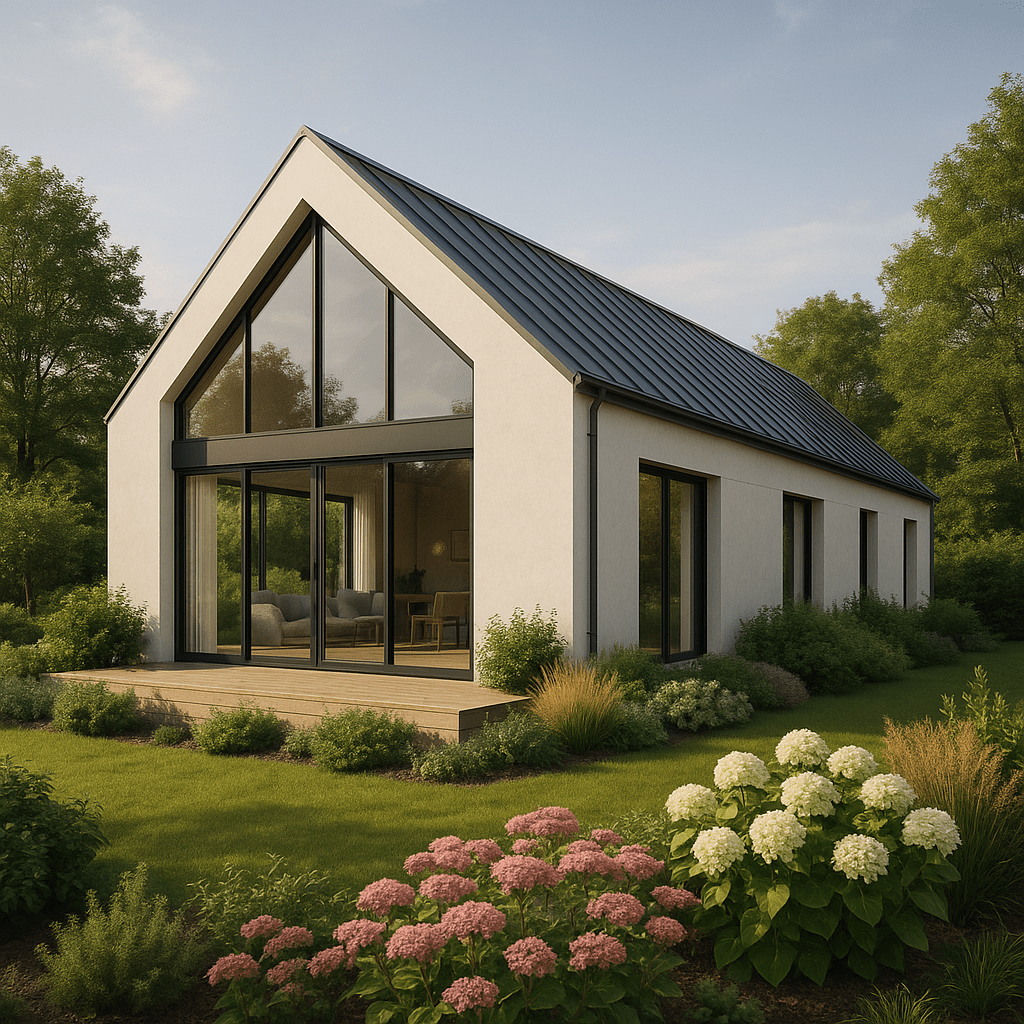
Panoramic glazing and high ceilings make barn houses offer:
- Maximum lighting thanks to floor-to-ceiling windows.
- Optically more space, even with a compact footprint.
- The natural combination of the living room with the garden, which promotes the well-being of the inhabitants.
Large, low-emission windows also help reduce electricity and light consumption.
Versatility and scalability
The barn style is perfect both in a compact version up to 70 m² (realized on request) and in a larger version with a mezzanine, garage or winter garden.
The possibility of easy adaptation of the project to the plot and the needs of the investor (different layouts, functions, styles) is a definite advantage compared to classic catalog projects.
Aesthetics that do not age
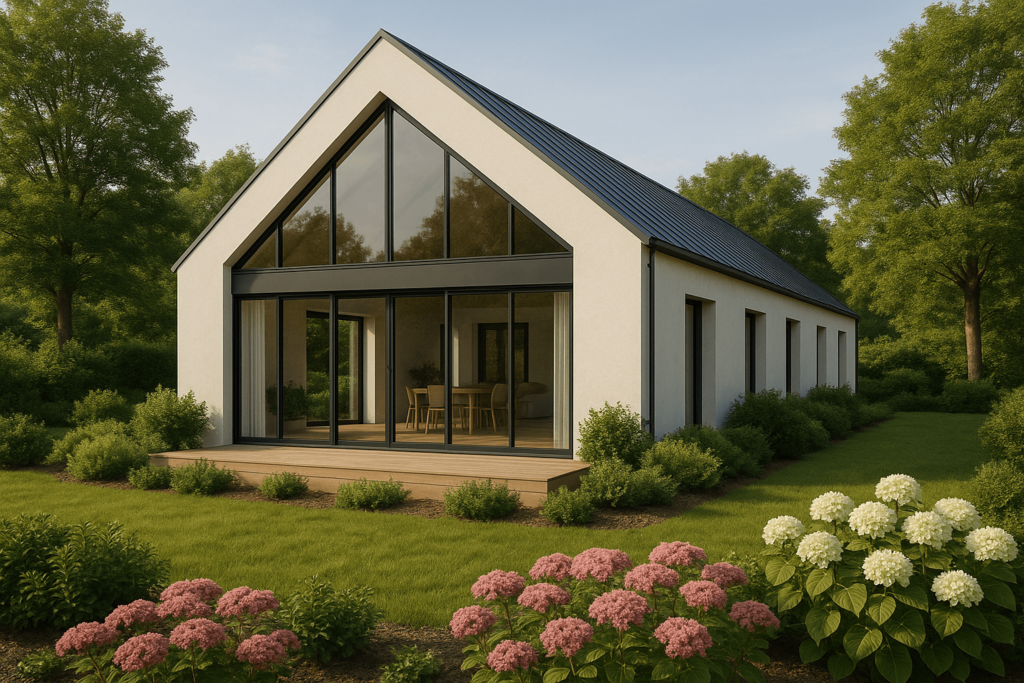
Barn-inspired homes are part of sustainable trends: minimalism, efficient energy management and closeness to nature.
- Studies show that buildings with high energy efficiency sell faster and at better prices.
- The modern barn style blends well with both rural and urban environments.
- Flexible interiors can be easily adapted to different styles - Scandinavian, loft or classic - which increases their investment attractiveness.
Disadvantages and limitations of a modern barn
Barn-style houses have many advantages, but like any architectural concept, they carry some limitations. It is good to know them before starting construction to avoid unpleasant and expensive surprises.
Glazing — comfort versus energy balance
Panoramic windows are one of the characteristic elements of this style, but they can be associated with some problems, such as:
- Overheating of interiors in summer, especially if the house is exposed to the sun from the south or west. Without adequate shading, the temperature inside can rise by a few degrees.
- Greater heat loss in winter compared to traditional walls, which can increase heating costs.
- The need for low-U glazing (≤0.8) and shading systems such as external blinds, blinds or pergolas.
Without proper sun protection, a “barn house” can become not only less comfortable, but also more expensive to maintain.
Little intimacy, a lot of exposure
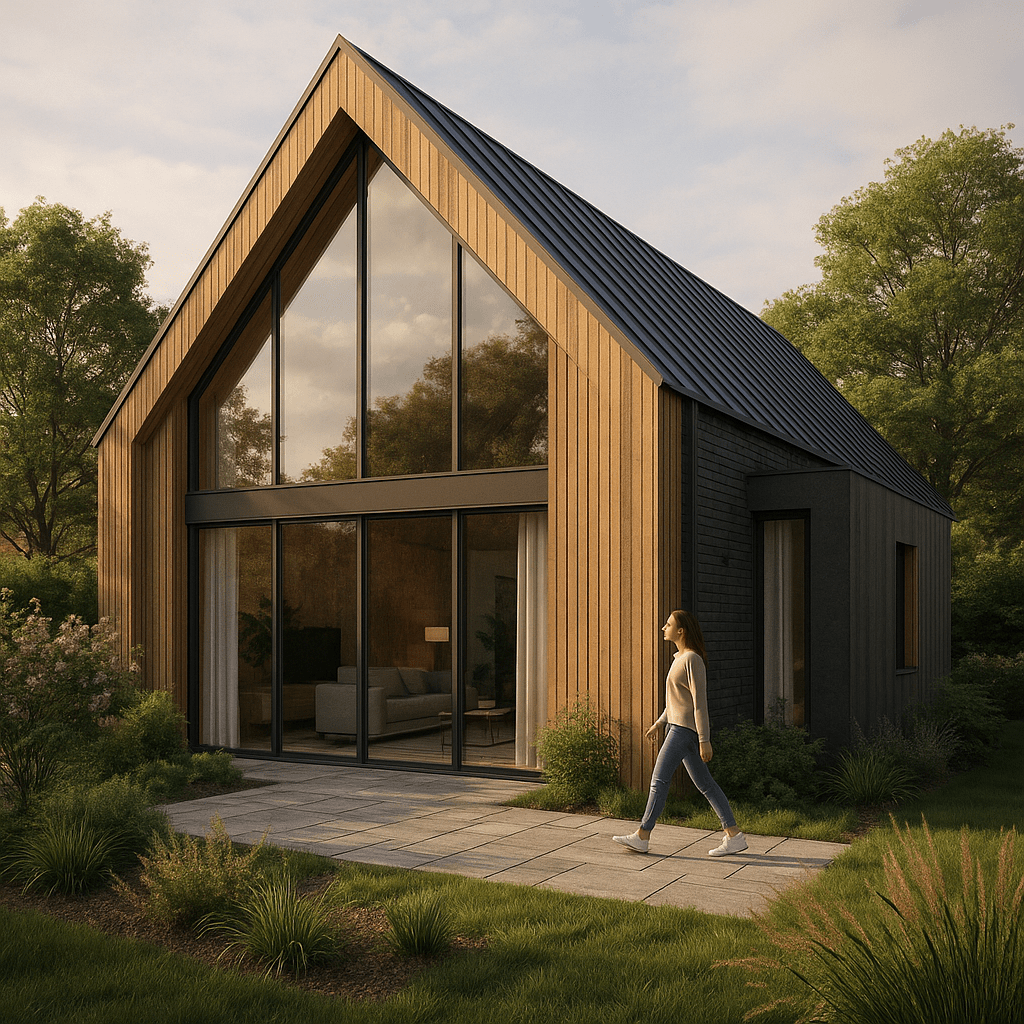
Barn-style homes are typically designed with an open space in mind and a close connection to their surroundings, but:
- There may be a lack of natural shelters from neighboring plots.
- Those who value privacy may need additional walls or shutters.
- It is worth thinking about the zoning of the interior - a clear separation of the living and sleeping zones, which will not negatively affect the aesthetics of the house.
Limitations of MPZP and building conditions
Not every plot is suitable for building a house in the style of a barn. You may encounter various limitations, such as:
- Requirements for the length of the eaves.
- The specified angle of inclination of the roof, which can vary from the minimalist 30°.
- Limits on the width of the front facade or the development of the plot.
Therefore, before proceeding with the project, it is worth checking what are the local regulations (MPZP or WZ) - the architect will help to adapt the project to these requirements.
Difficulty in expanding and changing functions
Due to its compact and defined form:
- Expanding a barn type home can be difficult and expensive.
- The project often lacks space for a garage, pantry or extra room.
- The mezzanine does not always provide the full functionality of the second level.
It is worthwhile to think carefully about the area and layout of the premises at the planning stage in order to avoid expensive adaptation after several years of use.
Is the modern barn just a fad or the future?
Trends in architecture are changing at a dizzying pace, but some of them, like barn-type houses, are gaining popularity and stability. This is no coincidence — it is the answer to the needs of modern investors who are looking for aesthetic, functional and sustainable solutions.
Why are barn houses so popular?
The growing popularity of barn houses is due to several key trends:
- Back to Simplicity and Nature — the style of the barn fits perfectly with the idea of slow life, which encourages living in harmony with the environment.
- Environmentally friendly technologies — houses of this type work well with renewable energy sources, heat pumps and recuperation systems.
- Increase in construction costs — their compact body allows for both time and material savings.
- Visual marketing — on Instagram and Pinterest, they often appear as “dream houses”, which attracts the attention of many people.
A barn house is a combination of aesthetics with practicality - it is not only a fashionable trend, but also a comfortable and profitable space for living or investment.
A trend that is developing
Even 5-10 years ago, modern barn houses were rare in Poland. Today:
- They can be found in the offer of almost every architectural studio,
- They are available in a variety of versions - from microhouses of 35 m² to spacious residences of 250 m²,
- They are increasingly used in commercial facilities such as hotels, guesthouses or restaurants.
This is not a momentary trend, but an evolution of form and function that has stayed with us for a long time.
Investment potential
Barn houses are becoming increasingly popular as investment projects:
- They are ideal for short-term rental - microhouses of 35 m² with a mezzanine can bring profit throughout the season.
- They are attractive to young buyers aged 25-45 who are looking for energy-saving and stylish solutions.
- They gain in value due to their durable aesthetics and functionality.
The increase in housing prices in Poland (about 13 400 PLN/m² in the first quarter of 2025) further confirms that the investment in a barn house can be a reasonable choice.
Practical tips for investors
The decision to build a barn-style house is just the beginning. In order to avoid costly mistakes and make the most of the potential of a modern barn, it is worth using some practical tips that have proven themselves in the work of architects from BRJ-Studio.
Orient the solid relative to the sides of the world
Both the comfort and the energy efficiency of your home depend largely on its orientation:
- It is best to direct large glazing to the south or southwest. Thanks to this, your home will be naturally lit and will gain passive heating in winter.
- Try to avoid windows facing north, as they can increase energy losses by up to 15— 20%.
- A covered terrace from the west is a great solution that allows you to enjoy the space without worrying about the interior overheating in summer.
Choose the right materials and technologies
The barn house “lives” on materials, so it is worth approaching their choice with caution:
- For facades, choose durable wood, such as thermo-wood or Siberian larch.
- If you are planning large glazing, opt for three-pane glazing with a Uw factor ≤ 0.9 — this can reduce heat loss by 30%.
- Remember about ecology and energy efficiency: the installation of photovoltaic panels, heat pumps and recuperation systems should be taken into account at the design stage.
Take care of proportions and details
Although the simple form of the barn has its charm, it is easy to spoil it:
- Too low a ridge will make the house look heavy.
- Excessively wide eaves or additional details can disrupt the minimalist style.
- Therefore, it is worth consulting with an architect who will help analyze the proportions and adapt the design to your plot and MPZP.
Check MPZP records or building conditions
This is a key element that often determines the success of an investment:
- Find out what are the requirements for the angle of inclination of the roof, the length of the eaves or the width of the front facade in your municipality.
- Adjust materials and colors to avoid corrections and delays in obtaining a permit.
Choose a project tailored to your needs
The design of the barn can be customized for different needs:
- A compact one-story house is a great option for a couple or a small family.
- The design with a mezzanine gives a feeling of spaciousness without the additional costs associated with the floor.
- You can also choose a version with a garage, a carport or additional rooms — it is ideal for larger families or special needs.
Well-thought-out solutions will help you maintain the spirit of a modern barn and avoid costly alterations in the future.
Summary — is the barn type house the future of Polish construction?
Barn-style homes are more than just a fashion trend or an attractive facade. It is a response to the real needs of modern investors who are looking for simplicity, functionality, energy efficiency and closeness to nature. Nowadays, barns take the form of full-fledged single-family houses, which perfectly fit into modern technologies, ecological standards and the comfort of living of residents.
If you are looking for a project that:
- is simple, but not banal,
- modern and at the same time refers to tradition,
- attracts the eye, but is thought out in terms of cost and ergonomics,
This barn type house can be a truly PHENOMENAL choice.
Why consider a barn type house?
- Minimalist solid — Simple form means lower construction and operating costs. Medium-sized companies and investors can save up to 10-20% at the implementation stage.
- Energy-saving “Thanks to compact construction and the right materials, barn houses work great with renewable energy sources, heat pumps and recuperation systems, which translates into lower bills.
- Timeless style — Rustic-modern homes maintain their value in the market and attract buyers aged 25-45 years. They often sell faster and more expensive.
- Comfort of life and conscious solutions — Large windows, open living spaces for the garden and natural materials affect the well-being and relaxation of residents.
The project starts with the architect — not with the visualizations themselves
The success of building a barn-type house starts with a solid concept. This is where BRJ-Studio comes into action — a team of experienced architects who:
- ensure compliance with regulations (MPZP, WZ),
- optimize the interior layout and proportions of the body,
- choose materials and technologies with energy efficiency, aesthetics and durability in mind.
Ready for the first step?
If you are thinking about building a barn-type house, regardless of whether you choose an individual project or adaptation of a ready-made solution — we invite you to BRJ-Studio for a free consultation. With us you will go through the entire process: from analysis, through concept, design, formalities, to implementation.
Make an appointment today and see if a barn style home is the right place for you!
Frequently Asked Questions (FAQ)
1. Is a barn style house cheaper to build?
Yes, in many cases, the construction of a barn-type house can be cheaper than more complex designs. Why? First of all, it is about the simplicity of construction. Note that these houses have a compact form, most often rectangular in shape, with a gable roof, without dormers and balconies, and without complex architectural details. This makes it possible to:
- the project is easier to design and implement,
- less materials are consumed,
- construction work takes less time,
- labor and execution costs are lower.
However, keep in mind that the final price is also influenced by other factors, such as the standard of finish, usable area, type of installation (for example, heat pump or recuperation) and the quality of glazing, which in barns play a key role.
2. Can a barn house be built without a permit?
According to the current regulations (the so-called Polish Law), it is possible to build a house with an area of up to 70 m² per application, which means that there is no need to obtain a building permit, keep a construction log or hire a construction manager. This also applies to barn-style houses, provided that:
- the house will be one-story (may have a mezzanine),
- is intended to serve as a single-family residential building,
- the investor will make appropriate declarations about the construction for his own needs.
If you are planning a larger area or an unusual shape, you will need to get permission. It is worth consulting the project with an architect who will assess whether it can be adapted to a simplified procedure.
3. What heating works best for a barn house?
Due to the compact body, a large amount of glazing and often open living space, barn-type houses need a well-thought-out heating system. The most commonly recommended solutions are:
- air-to-water heat pump, often combined with underfloor heating,
- recuperation (mechanical ventilation with heat recovery), which reduces heat loss with large windows,
- Photovoltaics, as a source of energy for heating systems.
It is also important to properly design windows, for example using selective glass with low thermal permeability, to reduce overheating in summer and heat loss in winter.
4. Does the barn fit any plot?
Unfortunately, not every plot is suitable for the construction of a barn-type house without making changes to the design. Restrictions may result from the provisions of the local zoning plan (MPZP) or the decision on building conditions (WZ). They may impose:
- minimum angle of inclination of the roof (for example, 35° instead of the standard 30°),
- the need to use eaves or specific facade materials,
- the maximum width of the front facade or the proportions of the building,
- specific location relative to the road or the boundaries of the plot.
Therefore, before choosing a ready-made project, it is worth consulting with an architect who will assess whether the construction of a barn house will be possible on your plot, or will suggest modifications in accordance with the regulations.
5. Is it worth building a barn type house in 2025?
Definitely yes! Barn-style homes combine what is most valued in architecture today: minimalism, functionality, energy efficiency and timeless style. They gain investment value, are easy to adapt to modern technologies (such as RES or smart home), and their simple form allows to reduce construction and operating costs.
This solution is ideal for both young families and people who value contact with nature, silence and space. A well-designed barn house will not only be aesthetic, but also comfortable and economical to use for many years.